Early Life and Formative Experiences
The birthplace of Frida Kahlo in 1907 was Coyoacán, a suburb of Mexico City, which at the time was more like a humble village. In her upbringing, cultural elements were mixed with personal adversities that would evolve into a vision of the world. She had a sickly and reclusive childhood which forced her into an introspective pursuit of a vivid inner world.
Those were her formative years. Gradually, Kahlo found her voice as an artist. Despite lacking any initial ambition to show painting skills, events in her young life kept pushing her toward aspects that redefined the arts of the 20th century.

Childhood, Illness, and Identity
Kahlo contracted polio at the age of six, leaving one leg thinner than the other. The condition caused physical discomfort and social difficulties, but it also cultivated resilience. During long periods of recovery, she developed independence and imagination. Her father, Guillermo Kahlo, a photographer of German descent, encouraged intellectual curiosity and exposed her to visual composition.
Growing up during the aftermath of the Mexican Revolution, she witnessed a country redefining itself. National identity, indigenous heritage, and cultural pride became central themes in public life. These currents would later surface in her art through traditional dress, symbolism, and a deliberate embrace of Mexican cultural roots.

The Bus Accident and a Turning Point
At eighteen, Kahlo’s life changed dramatically. A bus accident left her with severe injuries, including fractures to her spine and pelvis. The physical trauma required multiple surgeries and extended confinement to bed. During this period, she began painting seriously, using a specially constructed easel and a mirror mounted above her bed.
The accident did more than alter her physical condition; it redirected her ambitions. Originally interested in medicine, she turned inward, using art to process pain and survival. The mirror above her became a tool for self-study, and self-portraiture emerged as a central practice. What began as a method of coping would become the defining feature of her career.

Education and Intellectual Circles
Before the accident redirected her path, Kahlo attended the National Preparatory School in Mexico City, one of the country’s most prestigious institutions. She was among a small number of female students, an experience that exposed her early to questions of gender roles and opportunity. At school, she joined a group of politically engaged students known for their sharp wit and rebellious spirit. These friendships fostered debate about literature, philosophy, and national identity.
The intellectual environment broadened her perspective beyond domestic life. She encountered new scientific ideas, revolutionary politics, and artistic experimentation. Although she did not yet identify primarily as a painter, these formative discussions shaped her critical thinking. Later, the confidence to express controversial or intimate subjects in her art can be traced back to this period of intellectual awakening.

Family Influence and the Blue House
Kahlo’s family home, later known as the Blue House, played a central role in shaping her sense of belonging. The space blended European and Mexican influences, reflecting her mixed heritage. Her father’s photography studio introduced her to disciplined visual practice, while her mother’s strong attachment to Catholic tradition and indigenous culture grounded her in local customs.
The Blue House was more than a residence; it became a site of memory and identity. Its vivid cobalt walls, courtyard garden, and collection of folk art embodied the cultural pride that Kahlo later expressed through dress and symbolism. In time, the house would also become a gathering place for artists and political thinkers, reinforcing the connection between her personal life and the broader cultural movements unfolding in Mexico.
Artistic Development and Style
Kahlo's work is often connected with Surrealism, nevertheless, she refused to be referred to as a Surrealist based on her statements. She continued to argue that she did not paint dreams, only her own existence. Those paintings are amazingly detailed and full of abstract imagery that originates from Mexican folklore, Catholic imagery, and her personal thoughts.
An ever-evolving artiste, therefore, she is an act of disciplined technical brilliance. Even though they are small in proportion, every single piece carries within itself issues of individuality, the female, and mestiza identities.
Self-Portraiture as Self-Definition
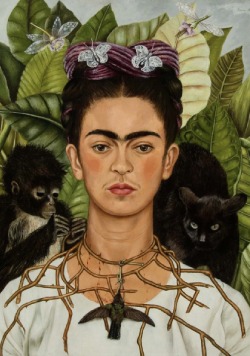
Self-portraits account for a significant portion of Kahlo’s body of work. In paintings such as Self-Portrait with Thorn Necklace and Hummingbird, she presents herself frontally, gazing directly at the viewer. The expression is often calm, even defiant, while surrounding elements convey struggle or symbolism. Thorn necklaces draw blood; animals hover as protectors or alter egos; foliage frames her like a stage.
These works function as visual autobiographies. Rather than idealizing herself, she depicts facial hair, unibrow, and physical scars without concealment. In doing so, she challenges conventional standards of beauty and femininity. The self-portrait becomes a site of control. By representing herself, she asserts authority over her narrative.
Symbolism, Pain, and the Body
Physical suffering appears frequently in Kahlo’s paintings. In The Broken Column, Kahlo depicts her body opened at the center, exposing a shattered classical pillar where her spine should be. Small nails press into her skin, suggesting constant, unrelenting pain, while her face remains steady and composed despite visible tears. The composition feels stark and unfiltered, forcing the viewer to confront vulnerability without distraction.
Rather than sentimentalizing pain, Kahlo externalizes it. She transforms private experience into symbolic language. Medical corsets, surgical scars, and anatomical references appear not as clinical details but as metaphors for vulnerability and endurance. The body becomes both subject and canvas, expressing the inseparability of physical and emotional states.
Mexicanidad and Cultural Roots
Kahlo embraced traditional Tehuana dress, elaborate hairstyles, and indigenous jewelry. This was not mere costume but a conscious alignment with Mexican identity. In the decades following the Mexican Revolution, artists sought to celebrate indigenous heritage and resist European dominance in culture.
Her visual vocabulary includes pre-Columbian artifacts, folk motifs, and vibrant color palettes associated with Mexican craft traditions. By situating herself within this cultural framework, she participated in a broader movement of national self-definition. At the same time, she personalized these elements, blending public symbolism with intimate storytelling.
Relationship with Diego Rivera and Political Context
The year 1929 saw the marriage of Frida Kahlo and Diego Rivera, a union that took her to the heart of Mexico's social and political scenes. Rivera, already one of the most famed muralists of the time, mused about work of monumental proportions around labor, class struggle, and revolutionary stances. Their association was mainly about passion and complexity in their mutual life.
This alliance vested Kahlo with the necessary connections and transitions in politics. Yet this had to be seen as separate from this matter of art on Rivera's broad establishments. Delving into public histories, she delved into the interior, into private personal narratives.
Artistic Exchange and Independence
Rivera recognized Kahlo’s talent early on and encouraged her development. The couple traveled to the United States, where Rivera received commissions for large murals. During these years, Kahlo observed industrial modernity and cultural contrasts, which informed works like Self-Portrait on the Borderline Between Mexico and the United States.
Despite Rivera’s fame, Kahlo resisted being overshadowed. Her paintings maintained an intimate scale and psychological focus. Over time, critics began to acknowledge her as a major artist in her own right. The dynamic between influence and independence became a defining aspect of her career.
Political Beliefs and Activism
Kahlo and Rivera were active members of the Mexican Communist Party. Their home, known as the Blue House, hosted intellectuals and political figures, including Leon Trotsky during his exile. Political ideology shaped Kahlo’s worldview, though it appeared more subtly in her work compared to Rivera’s murals.
Her commitment to social justice intersected with personal identity. By embracing indigenous heritage and challenging gender norms, she enacted political resistance through self-representation. Art became both expression and statement, aligning personal truth with broader struggles for equality and recognition.
Public Image and Personal Autonomy
As Rivera’s international reputation grew, Kahlo became increasingly aware of how she was perceived in public. While she often appeared alongside him at exhibitions and social gatherings, she cultivated a distinct visual identity that reinforced her independence. Her choice of traditional Tehuana dress, elaborate jewelry, and carefully styled hair was not only an embrace of Mexican heritage but also a deliberate assertion of self-definition within elite artistic circles.
This crafted public image functioned as both armor and statement. In photographs and public appearances, she projected composure and control, countering narratives that framed her primarily as Rivera’s wife. The tension between partnership and autonomy sharpened her resolve to maintain a separate artistic voice. Over time, collectors and critics began to focus more directly on her paintings, recognizing that her intimate, symbolic works operated on a different but equally powerful scale compared to Rivera’s monumental murals.
Recognition During Her Lifetime
Although today Kahlo is internationally celebrated, recognition during her lifetime was gradual. She exhibited in New York and Paris, gaining attention from figures in the Surrealist movement. André Breton praised her work, though she remained ambivalent about such classifications.
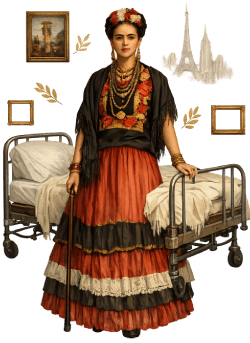
In Mexico, she participated in group exhibitions and eventually had a solo show in 1953. By that time, her health had severely declined. She attended the opening lying on a bed placed in the gallery, greeting visitors despite physical hardship. The image of Kahlo, frail yet present, reinforced her public identity as resilient and uncompromising.
Critical Reception and Artistic Circles
European and American audiences often viewed Kahlo through exoticizing lenses, emphasizing perceived “primitivism.” While this framing brought attention, it risked simplifying her complex engagement with culture. Over time, scholars reassessed her work, recognizing its intellectual depth and formal sophistication.
Her participation in international exhibitions expanded awareness of Mexican modernism. Even so, for decades after her death in 1954, her reputation remained intertwined with Rivera’s. Only later did art historians fully foreground her independent contributions.
Market Presence and Collectors
During her lifetime, Kahlo’s commercial success was modest but meaningful. A small circle of collectors in the United States and Mexico began acquiring her paintings in the 1930s and 1940s, recognizing the originality of her vision. Sales were not frequent, yet they provided validation that her intensely personal imagery resonated beyond her immediate circle. For Kahlo, each purchase signaled acknowledgment that her private symbols could communicate to strangers.
At the same time, the art market of the period was not structured to favor artists working on an intimate scale, especially women exploring autobiographical themes. Large murals and monumental public works often attracted more institutional support. Kahlo’s persistence within this environment underscores her commitment to subject matter that did not conform to dominant trends. Though financial rewards were limited, the foundation was laid for the dramatic reassessment and market growth that would follow decades later.
Posthumous Rise and Global Influence
In the decades following her death, interest in Kahlo grew steadily. The feminist movements of the 1970s played a significant role in reintroducing her work to new audiences. Scholars and activists saw in her paintings a powerful articulation of female subjectivity and bodily autonomy.
Museums and retrospectives brought her art to international stages. Her face, framed by flowers and an unwavering gaze, became a cultural icon recognized far beyond art history circles.
Feminism and the Politics of the Body
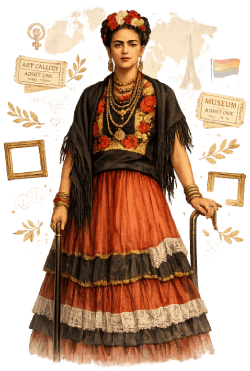
Kahlo’s frank depiction of miscarriage, infertility, and physical injury resonated with feminist scholars seeking representations of women’s lived realities. She neither romanticized nor concealed these experiences. Instead, she asserted them as worthy of artistic treatment.
Her refusal to conform to narrow beauty standards also gained symbolic weight. The unibrow and faint mustache became emblems of self-acceptance. In contemporary discussions about body positivity and gender expression, her imagery continues to circulate as a reference point.
Queer Identity and Fluidity
Kahlo’s bisexual relationships and exploration of gender presentation have contributed to her significance within LGBTQ+ communities. Some of her self-portraits incorporate traditionally masculine elements, subtly questioning rigid categories of identity.
By presenting herself in varied roles, she destabilized fixed definitions. Her art invites viewers to consider identity as layered and evolving. This perspective aligns with current conversations about intersectionality and the complexity of selfhood.
Commercialization and Cultural Memory
Today, Kahlo’s image appears on clothing, accessories, and popular media. While this visibility broadens awareness, it also raises questions about commodification. The tension between artistic integrity and commercial adaptation reflects broader debates about cultural memory.
Despite commercialization, her paintings retain emotional intensity. Museum exhibitions continue to draw large audiences, suggesting that beyond iconography lies a sustained engagement with the work itself. Viewers are drawn not only to the image of Kahlo, but to the honesty embedded in her art.
Why Frida Kahlo Still Resonates
Kahlo’s enduring relevance stems from the authenticity of her voice. She painted personal realities without dilution. In a world saturated with curated images, her directness feels strikingly modern.
Her work bridges private experience and collective identity. Themes of migration, cultural heritage, disability, and gender remain central to global discourse. Kahlo’s paintings offer a visual language for these concerns, demonstrating how individual stories can illuminate broader truths.
Resilience Without Simplification
Kahlo is often described as a symbol of strength, yet her art does not reduce suffering to triumph. Instead, it acknowledges fragility alongside endurance. This nuanced portrayal allows contemporary audiences to see resilience as complex rather than heroic in a conventional sense.
By refusing to erase pain, she validates it. Viewers confronting their own challenges may find recognition rather than instruction in her work. The paintings do not prescribe solutions; they affirm experience.
Visual Identity in a Global Era
In an interconnected world, questions of cultural belonging and hybrid identity are increasingly prominent. Kahlo’s blending of European and Mexican heritage mirrors contemporary multicultural realities. She claimed space for layered identity without apology.
Her visual consistency, particularly in self-portraiture, also anticipates modern practices of self-imaging. While today’s digital self-representation differs in medium, the impulse to define oneself visually remains similar. Kahlo’s paintings can be read as early, deeply reflective acts of self-curation.
A Gaze That Endures
Although her biography is essential, the artistic vision of Frida Kahlo is yet another reason for her great legacy. She made her personal misfortune into the images that continue speaking through generations. Her work has roots that remain in the past yet climbs high to avoid the present.
There is suggestion from her calm gaze that her work is an invitation to the kind of dialogue that holds its own against mute admiration from an audience. Through that language she conceived while lived across pain, identity, and dissociation, we have no one who can sit down with her and interpret her language. She stands not only as an icon but as an artist whose authenticity still speaks to the world.
Frida Kahlo
— Art Guide (@ArtGuide_db) February 19, 2026
Self-Portrait in a Velvet Dress pic.twitter.com/Z78DyKIg7N